

How a PSLE composition is marked: the rubric, explained

Most explanations of PSLE composition marking stop at "content and language". That is true and useless. It does not tell a parent why one script got 24 and another got 32, and it does not help a teacher explain the gap to the child who wrote the 24.
Here is the actual rubric, band by band, with two real scripts marked against it.
The marks
Continuous writing for Primary 5 and 6 carries 36 marks, split evenly:
| Criterion | Marks | What it covers |
|---|---|---|
| Content | 18 | Relevance, interest, and development of ideas |
| Language & Organisation | 18 | Grammar, expression, vocabulary, sequencing, paragraphing, linking |
Both criteria run across six levels: No Credit, Beginning, Developing, Satisfactory, Proficient, Exemplary.
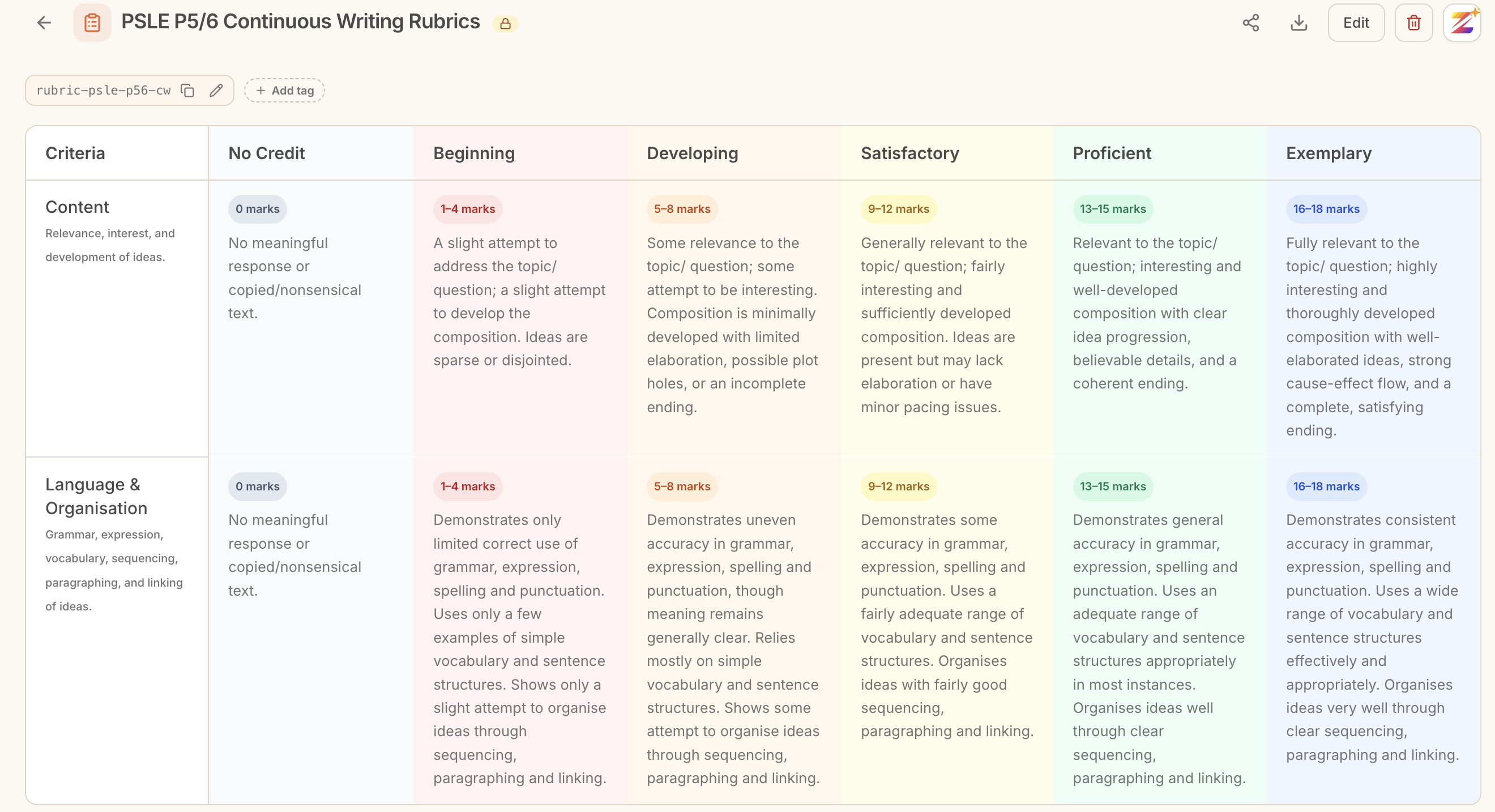
The same rubric as Zippy holds it. Both criteria carry the same six bands and the same mark ranges: 0, then 1–4, 5–8, 9–12, 13–15, 16–18.
Content, band by band
| Band | Marks | What the script does |
|---|---|---|
| No Credit | 0 | No meaningful response, or copied text |
| Beginning | 1–4 | A slight attempt at the topic. Ideas sparse or disjointed |
| Developing | 5–8 | Some relevance, some attempt to interest. Minimally developed, limited elaboration, possible plot holes or an incomplete ending |
| Satisfactory | 9–12 | Generally relevant, fairly interesting, sufficiently developed. Ideas present but may lack elaboration or have minor pacing issues |
| Proficient | 13–15 | Relevant, interesting, well developed. Clear idea progression, believable details, coherent ending |
| Exemplary | 16–18 | Fully relevant, highly interesting, thoroughly developed. Well-elaborated ideas, strong cause-effect flow, complete and satisfying ending |
Read the jump from Satisfactory to Proficient closely, because that is where most compositions sit and where most marks are won. It is not about better words. It is elaboration, idea progression and an ending that actually lands. "Sufficiently developed" becomes "well developed"; "may lack elaboration" becomes "believable details".
Language & Organisation, band by band
| Band | Marks | What the script does |
|---|---|---|
| No Credit | 0 | No meaningful response, or copied text |
| Beginning | 1–4 | Limited correct use of grammar, expression, spelling, punctuation. A few examples of simple vocabulary and sentence structures |
| Developing | 5–8 | Uneven accuracy, though meaning generally clear. Relies mostly on simple vocabulary and structures |
| Satisfactory | 9–12 | Some accuracy. Fairly adequate range of vocabulary and structures. Fairly good sequencing, paragraphing and linking |
| Proficient | 13–15 | General accuracy. Adequate range used appropriately in most instances. Ideas organised well through clear sequencing and linking |
| Exemplary | 16–18 | Consistent accuracy. Wide range used effectively and appropriately. Ideas organised very well |
Note what the top band does not say. It does not ask for long words. It asks for a wide range used effectively and appropriately, which is a different instruction, and a kinder one. A well-placed short sentence counts. A misused "surreptitiously" does not.
How the marks are actually awarded
Four principles govern the marking, and they matter more than the band descriptors:
Best-fit level first, then the mark within it. A marker decides the band from the overall impression, then fixes the exact number. They do not add up points for individual features.
Positive marking. Marks are awarded for what the script clearly demonstrates, not deducted for what is missing.
Consistency. Small edits should not cause large score changes. Only a meaningful improvement should shift the band.
Zero is reserved. It is for blank, nonsensical or copied responses. Not for bad.
There is one hard rule worth knowing: if the script does not address the topic, Language & Organisation is capped at 12 marks. A beautifully written composition about the wrong thing cannot reach the top bands. This is the single most expensive mistake a strong writer makes.
Two scripts, marked
"Making a difficult choice", 32/36. A boy finds a wallet holding more than a thousand dollars while his mother is in hospital with lung cancer. He takes it, feels the guilt settle "like a heavy stone", shows his mother, and returns it the next morning.
| Criterion | Band | Marks | Why |
|---|---|---|---|
| Content | Exemplary | 16/18 | Strong cause-effect flow: illness → temptation → guilt → redemption. Believable motivations, ending tied to theme |
| Language & Organisation | Proficient–Exemplary | 16/18 | Consistent accuracy, wide vocabulary used effectively, short sentences for impact: "She did not need to." |
The structural move that earns the Content mark is that the choice is made, regretted, corrected, and then reflected on. Choice → consequence → lesson. Mid-band scripts describe a difficult choice. Top-band scripts complete that loop.
"Being thankful" (PSLE 2025), 34/36. A boy bored at a class party knocks over a bookshelf, finds a biscuit tin of letters written by the 2021 cohort during the pandemic, and rejoins the party.
| Criterion | Band | Marks | Why |
|---|---|---|---|
| Content | Exemplary | 17/18 | Theme woven through the story rather than stated at the end. Complete, emotionally satisfying ending |
| Language & Organisation | Exemplary | 17/18 | "revelled", "cascaded", "faint, as if written by shaking hands". Fragments used deliberately: "The pandemic years." |
The difference between 32 and 34 is not vocabulary. Both scripts have strong vocabulary. It is that the second one never states its theme. Archie does not tell you he is grateful; you watch him change. Showing rather than telling is the defining quality of the top Content band, and it is teachable in a way that "use better words" is not.
What this does not tell you
A rubric is a measuring instrument, and every measuring instrument has things it cannot see.
It cannot see voice. The line "the whole affair was nothing more than a long yawn dressed in crepe paper" is the funniest thing in either script. It earns its marks under "wide range used effectively", but nothing in the descriptor is reaching for that. A child can score 30 with no discernible personality on the page.
Two markers can disagree inside a band and both be right. Content 16 and Content 17 are genuinely close. If your child's script came back a mark below what you expected, that is usually the honest width of the band, not an error.
It says nothing about improvement. A script that moves from 18 to 24 in a term is a significant achievement, and the rubric has no way to record that. Only the teacher who saw both drafts knows.
A mark is not a diagnosis. "Content 11" tells you the band. It does not tell you the child buried a good idea in paragraph four, or ended two sentences early because they ran out of time. That reading is the teacher's job, and it is the part that actually changes the next composition.
Applying it across a class
Knowing the six bands is one thing. Applying them the same way to script 3 and script 30, at eleven at night, is the part nobody writes rubrics about, and it is where a class set stops being a marking problem and starts being a fairness one.
How AI helps teachers mark PSLE compositions covers what that looks like in practice, including photographed handwriting and how often a machine agrees with a human marker.
The secondary equivalent is O-Level Situational Writing, which splits its 30 marks differently. If you want to see this rubric applied to a whole class rather than one script, marking thirty PSLE compositions walks through it, and AI grading is only as good as the rubric behind it covers how the bands are configured.
The rubric above is the one Zippy grades PSLE continuous writing against, and it is syllabus-aligned rather than an official SEAB publication. For the authoritative subject requirements, check the current MOE English syllabus and SEAB's examination materials.