
PSLE Stimulus-Based Conversation: how to answer any photo

Most children lose marks in the Stimulus-Based Conversation not because they have nothing to say, but because they say it in one short line and stop. "It's a family eating dinner." Full stop. The examiner waits; the child freezes.
We're going to look at this the way an assessor does, at where each mark is actually awarded, and then give your child two simple habits that hit those marks every time: describing the photo in full, and backing up an opinion with a reason. They're not magic formulas (every tutor in Singapore teaches some version of them); what matters is seeing why the fuller answer scores and the short one doesn't. Once your child sees that, they can talk about any photo the examiner puts in front of them.
First, what SBC actually asks
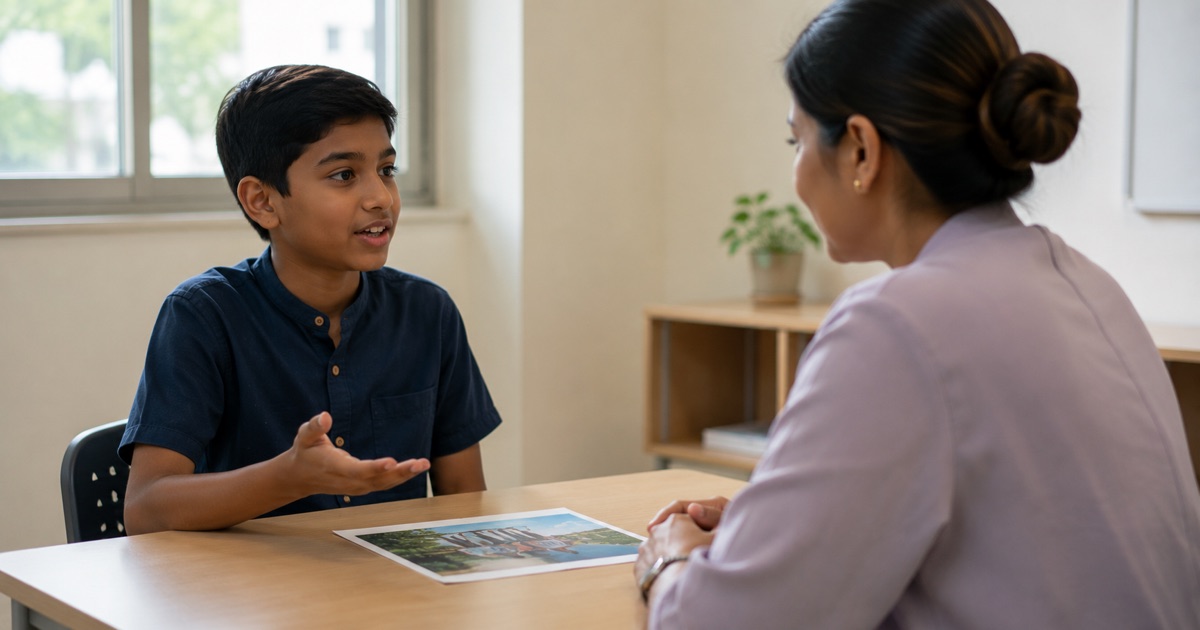
Your child is shown a real photograph and then answers a short set of questions (usually three). The first question is tied directly to the photo ("Tell me what you see" / "What is happening here?"). The later questions open outwards into their own views and experiences on the theme ("Do you think children today spend enough time outdoors? Why?").
So the child needs two different tools: one for describing, one for giving opinions.
Tool 1: Describe the photo with 5W1H
When the question is about the picture, run through six quick prompts:
| Prompt | Turns into… | |
|---|---|---|
| Who | Who is in the photo? | "A mother and two young children…" |
| What | What are they doing? | "…are cooking together in the kitchen." |
| Where | Where is this? | "It looks like a home kitchen…" |
| When | What time / occasion? | "…perhaps in the evening, preparing dinner." |
| Why | Why might this be happening? | "They may be making a family meal together as a weekend activity." |
| How | How do they seem to feel? | "Everyone is smiling, so they look happy and relaxed." |
Weak answer: "It's a family cooking."
Strong answer (5W1H): "In the photo, a mother and her two young children are cooking together in what looks like their home kitchen, perhaps preparing dinner in the evening. They are all smiling, so they seem happy and to be enjoying spending time together."
Same photo. One is a fragment; the other is a confident, complete answer, and your child built it just by walking through six questions.
Teach the habit, not the script. Don't have your child memorise that paragraph. Have them practise the six questions on ten different photos until running through them becomes automatic.
Tool 2: Give opinions with PEEL
When the question asks what your child thinks, use PEEL:
- P for Point: state your view clearly. "I think families should cook together whenever they can."
- E for Evidence: give an example. "For example, my family makes dumplings together every Sunday."
- E for Explanation: say why it matters. "It gives us a chance to talk and catch up after a busy week."
- L for Link: tie back to the question. "So I believe cooking together is a good way for families to bond."
Weak answer: "Yes, cooking together is good."
Strong answer (PEEL): the four lines above: a complete, organised opinion that sounds thoughtful without being memorised.
Putting it together: a full mini-run
Examiner: "What do you see in this photo?" Child (5W1H): "I can see a mother and two children cooking together in their kitchen, probably making dinner. They are smiling and look like they're enjoying it."
Examiner: "Do you enjoy helping out at home? Why?" Child (PEEL): "Yes, I do. For example, I help wash the vegetables when my mother cooks. It makes her work easier and I get to learn how to prepare simple dishes. So I feel helping at home is both useful and rewarding."
That's the whole skill. Two frameworks, endless topics.
How you can help at home tonight
- The 10-minute photo game. Open your phone gallery or a news site. Pick a photo. Child describes it with 5W1H, then you ask one opinion question they answer with PEEL. Do three photos. Done.
- Vary the themes. Rotate everyday topics: family, school, hobbies, food, the environment, helping others, technology, National Day. These are the kinds of themes SBC draws on.
- Fillers cost fluency. If your child leans on "uhm" and "like", teach a graceful stall instead: "That's an interesting question, I think…" It buys thinking time and sounds composed.
- Praise structure, not just content. When they naturally hit all four PEEL steps, name it: "That was a full answer, point, example, reason, and you linked it back." Recognition makes the habit stick.
Practise with ready-made prompts
You don't have to invent photos and questions every night. Our free PSLE SBC practice sets give you photo prompts with example questions and model answers built on 5W1H and PEEL, so your child can see exactly what a strong response looks like, then try their own.
These free guides come from the team behind Zippy, which gives teachers and tutors fast, specific feedback on student English. Try the live grader →
Related: PSLE Oral 2026: Complete Parent's Guide · Reading Aloud: Full Marks