

Oral tests: marking how it was said and what was said

Oral is the part of English that scales worst. Forty children, two minutes each, and the child who most needs to be heard is usually the one who has learned to go quiet. Most weeks, the oral practice that happens is the practice a parent supervises at home.
There is a second problem under that one. Marking an oral means holding two judgements at the same time. Was it clear and fluent, and was the answer any good. A child can read beautifully and answer a different question, and one number cannot say both things.
Two rubrics on the same question
You can now put more than one rubric on a question, so an oral test carries both judgements.
The first is a speaking rubric. Pronunciation and fluency are scored by the speech engine, which listens to the recording instead of reading a transcript of it. Content and comprehension are marked from what the child actually said. That is the rubric we ship: four criteria, 20 marks. Intonation and completeness are there too, for reading-aloud tasks where there is a passage to be complete against.
The second is your own marking scheme, unchanged. In the example below it is the PSLE Primary 5/6 continuous-writing rubric from the Discover library: content and language, 18 marks each, the same grid your department already argues about in a moderation meeting.
Put both in a preset, and point the question at the preset. Here is that setup, one rubric at a time and then the two together.
Every mark comes from a rubric you control.
One recording is marked against both rubrics in one pass. Each keeps its own marks, so a criterion out of 18 is reported out of 18 even when it sits beside one out of 5.
The child speaks it, or uploads a clip
Press record in the browser, or upload a file. A rehearsal recorded at home on a phone comes in the same way and is marked the same way. Nothing has to be scheduled, and nobody has to be in the room.
An oral question, in the student portal.
What comes back
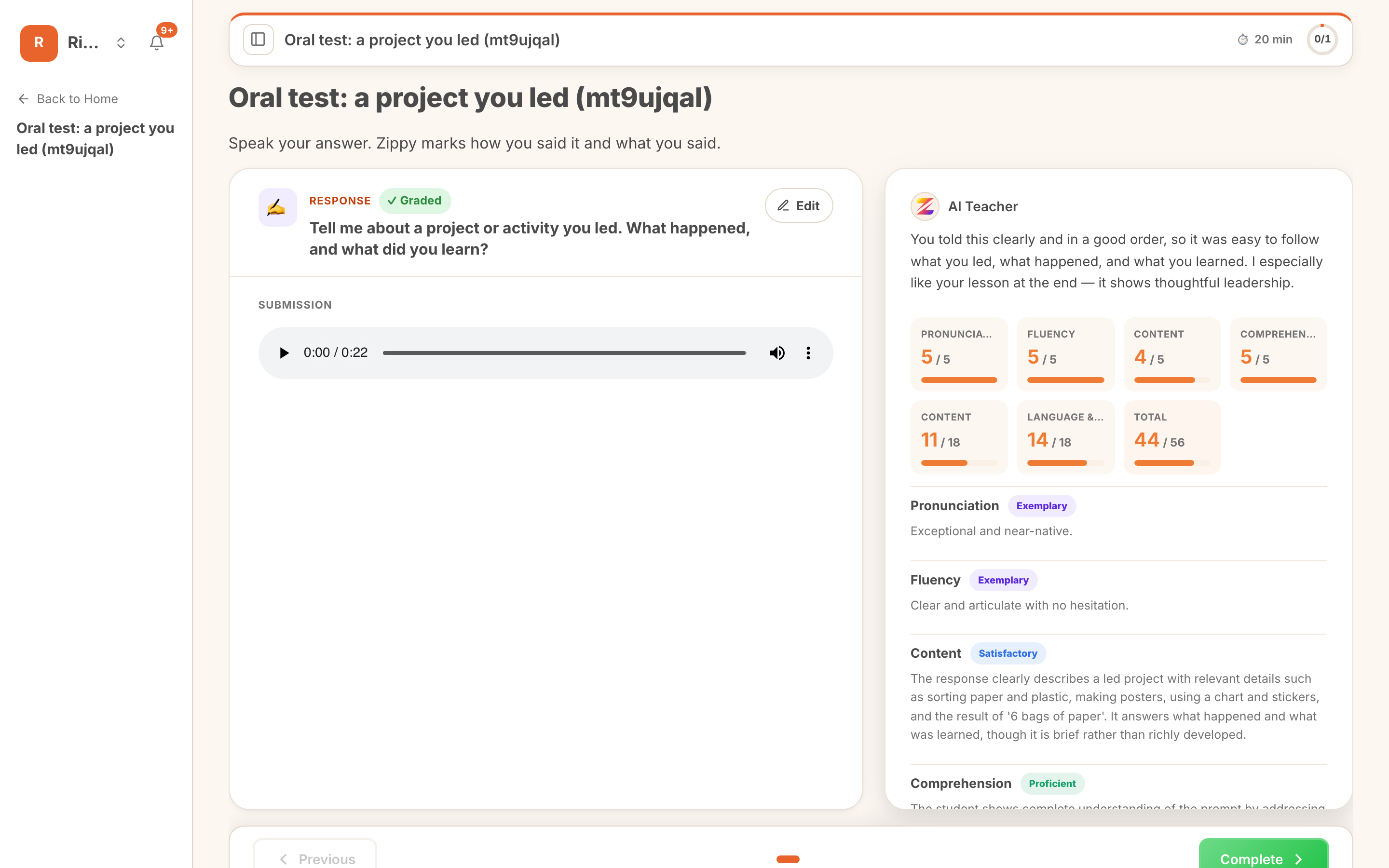
That is a real submission, answering tell me about a project or activity you led.
The speech engine heard it clearly: pronunciation 5 out of 5, fluency 5, both banded exemplary. On the speaking rubric, content 4 out of 5 and comprehension 5. The same twenty-two seconds of speech went to the writing rubric as well, where it scored content 11 out of 18, because the ideas are concise and only fairly elaborated, and language and organisation 14 out of 18. Forty-four out of fifty-six in total, and under every number a sentence naming what earned it.
Six numbers is more than a child needs to hear at once, which is a choice you make when you build the preset. A Primary 4 reading test might report pronunciation and completeness and nothing else. An oral exam rehearsal in Primary 6 wants the lot. Rubric types lists what each criterion measures, and configuring rubrics covers building the preset.
You still hold the pen
The marks arrive for you first. Change a score, rewrite a comment, send it back for another go, or release it as it stands. A child sees what you approve, when you approve it. Zippy does the listening so your attention goes to the four children whose scores moved.
What this does not solve
It marks delivery and content, not confidence. A child who freezes in front of a stranger is not measured by any of this.
It hears one recording. Nerves on a Tuesday afternoon are not a language problem, and a single low fluency score is a reason to listen yourself rather than a verdict.
Two rubrics also mean two sets of numbers, and a child who is handed six of them will read the lowest one and stop. Decide what to report before you set the preset, not after the marks come back.
And it is English. The speech engine handles other languages, but the rubric we ship is written for English oral, so anything else starts from your own criteria.
If you want the marking scheme behind it, we wrote up how PSLE Reading Aloud is scored and a parent's guide to the whole paper.