
What If AI Gave Teachers Their Evenings Back?

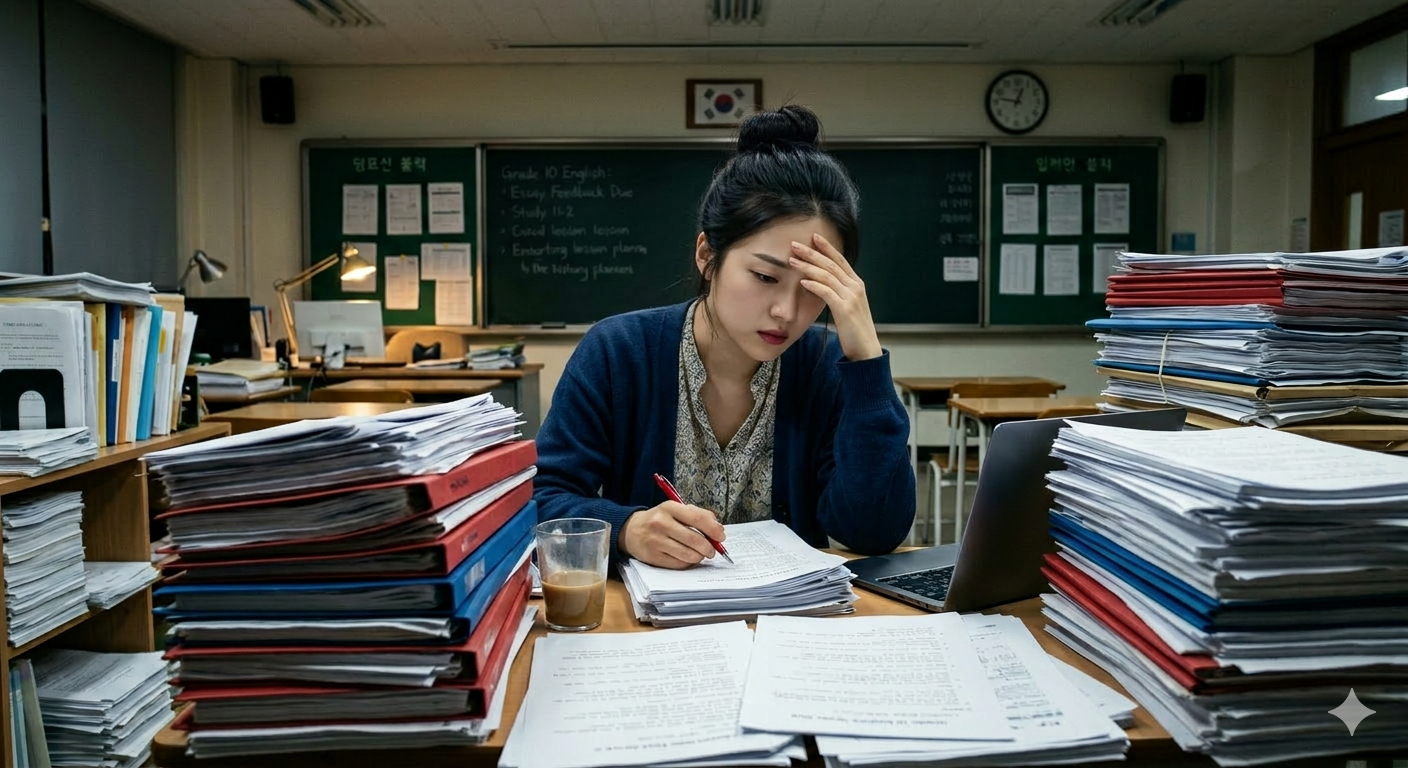
I keep having the same conversation with teachers. A set of forty essays can swallow most of a weekend. The first few get real, thoughtful comments. By essay twenty-five, it is eleven at night, and there are still fifteen more to go.
Most teachers did not enter the profession to mark stacks of work at midnight. They came for the human part. So when AI comes up, the hesitation is specific: will handing work to a machine cost them the instinct that made them good in the first place?
The conversation I keep having
An English teacher told me that a set of forty essays can swallow most of her weekend. The first few get real, thoughtful comments. By essay twenty-five, it is eleven at night, she is running on fumes, and there are still fifteen more to go before she can even think about her own life.
That is not something most of us signed up for.
It is relentless. It drains everything. And the moment one set is done, the next one is already waiting.
That is the part we do not say enough. Most teachers did not enter the profession to mark stacks of work at midnight. They came for the human part: reading the room, noticing the child who has gone quiet, knowing who needs a push, who needs encouragement, and who just needs someone to believe they can do better.
But between the grading, planning, tracking, reporting, and administrative work, there is less and less space left for that.
The fear is fair
When AI comes up, most teachers are not simply "against it." The hesitation is more specific.
They worry that handing work to a machine means slowly losing the instinct that made them good in the first place. The feel for their students. The judgment behind a grade. The ability to spot what is not written on the page.
Honestly, that fear is fair.
Bad tools can flatten teaching. They can turn professional judgment into a button. They can make feedback sound efficient but empty.
But that only happens if the tool is built without keeping the teacher in the loop.
So what if we imagined the opposite? What if AI was not there to replace the teacher's judgment, but to protect it?
That is the version we set out to build with Zippy. Here is what that looks like in practice.
Mark a whole class without losing your evenings
This is what Zippy's grading is for. You bulk import a class set of essays, compositions, problem sets, or reflections, a folder of scripts, all at once.
Zippy does a first read against your rubric, the one aligned to the skills you actually teach. It drafts inline, personalised feedback for every student and surfaces a suggested score against each rubric criterion.
But it is only a draft.
You skim the AI scores, change anything you disagree with, and add the sentence only you would write because you know this child had a rough week. You approve in bulk.
Grades and feedback go out to students only after your sign-off. Nothing reaches them until you say so.
The difference is that the last script in the pile gets the same fresh attention as the first, because you are no longer carrying the whole pile alone.
See your whole class clearly, in one view
When the grades are in, Zippy's tracking turns them into patterns you can act on. You open the gradebook and it is all there: this student is improving steadily, that student has started slipping, and six students keep losing marks for the same skill across the skill map.
That last one is not six separate problems. It is one ten-minute reteach on Tuesday.
And when you need to put it into words, you just ask. Type "How is Sarah doing?" and Zippy writes a parent-ready summary you can drop straight into a report, grounded in her actual work, not guesswork.
Teachers already know what to do with patterns. The problem is that the patterns usually stay buried under unmarked work, spreadsheets, and memory until it is too late to act on them. Zippy keeps them on the surface.
Meet every child where they are
We say this all the time in education. Meet students where they are. But in a real classroom, with thirty or forty students, it can feel almost impossible.
With Zippy's Create tools, it stops costing you an evening. Tell the AI what you want to teach and it drafts the lesson, the questions, and the rubric, aligned to your skill map.
Need a quiz, a worksheet, or a quick exit ticket on the same topic? Generate it in minutes. One worksheet can become three versions for three different levels.
And you never have to start from a blank page: clone a ready-made lesson from the library and adapt it to your class.
You would still be the one who knows that Maya needs confidence before correction this week, and that Daniel is ready to be pushed harder than he thinks.
Zippy handles the volume. You keep the relationship.
Imagine a week that gives something back
That is the version of AI in education we are interested in.
Not AI as the teacher. Not AI as the judge. Not AI as a shiny shortcut.
AI as the first pass. The organiser. The pattern-finder. The assistant that clears enough space for teachers to do the work only teachers can do. That is exactly the shape of Zippy: create the lesson, grade the first pass, track the patterns, and you review, approve, and decide every step.
Because when the marking shrinks, the tracking becomes clearer, and the prep gets faster, something important comes back.
Time.
Time for the lesson you have wanted to try for months. Time to catch the three students who are slipping before they slip further. Time to give better feedback, not just faster feedback. And maybe, sometimes, time to shut the laptop at a decent hour and still have something left for yourself.
That future is closer than the marking pile on the kitchen table makes it feel.
The question is what kind of AI we build
The real question is not whether AI enters education. It already has.
The question is what kind of AI we build. Do we build tools that quietly push teachers out of the centre? Or do we build tools that keep teachers firmly in the driver's seat, with better visibility, better support, and more time to do the human work?
That is the line we hold at Zippy. AI drafts the lesson, takes the first pass at grading, and surfaces the patterns across your class, but you review, approve, and decide every step. Zippy suggests. You decide.
We know which version we want to live in.