
Will AI replace teachers? Why the best classroom AI keeps you in control

"Will AI replace teachers?" is the question every staffroom is asking, and it is the wrong one to be afraid of. The useful question is narrower: what should AI take off a teacher's plate, and what should never leave their hands? Get that line right and AI becomes leverage, not a threat.
The fear is fair
Teachers are not simply "against" AI. The hesitation is specific: that handing work to a machine slowly costs you the instinct that made you good in the first place. The feel for your students. The judgement behind a grade. The ability to spot what is not written on the page.
That fear is fair, because bad tools really can flatten teaching. They turn professional judgement into a button and make feedback sound efficient but empty. It only goes wrong, though, when the tool is built without keeping the teacher in the loop.
What AI should take off your plate
The parts of teaching that scale badly are exactly the parts worth handing over:
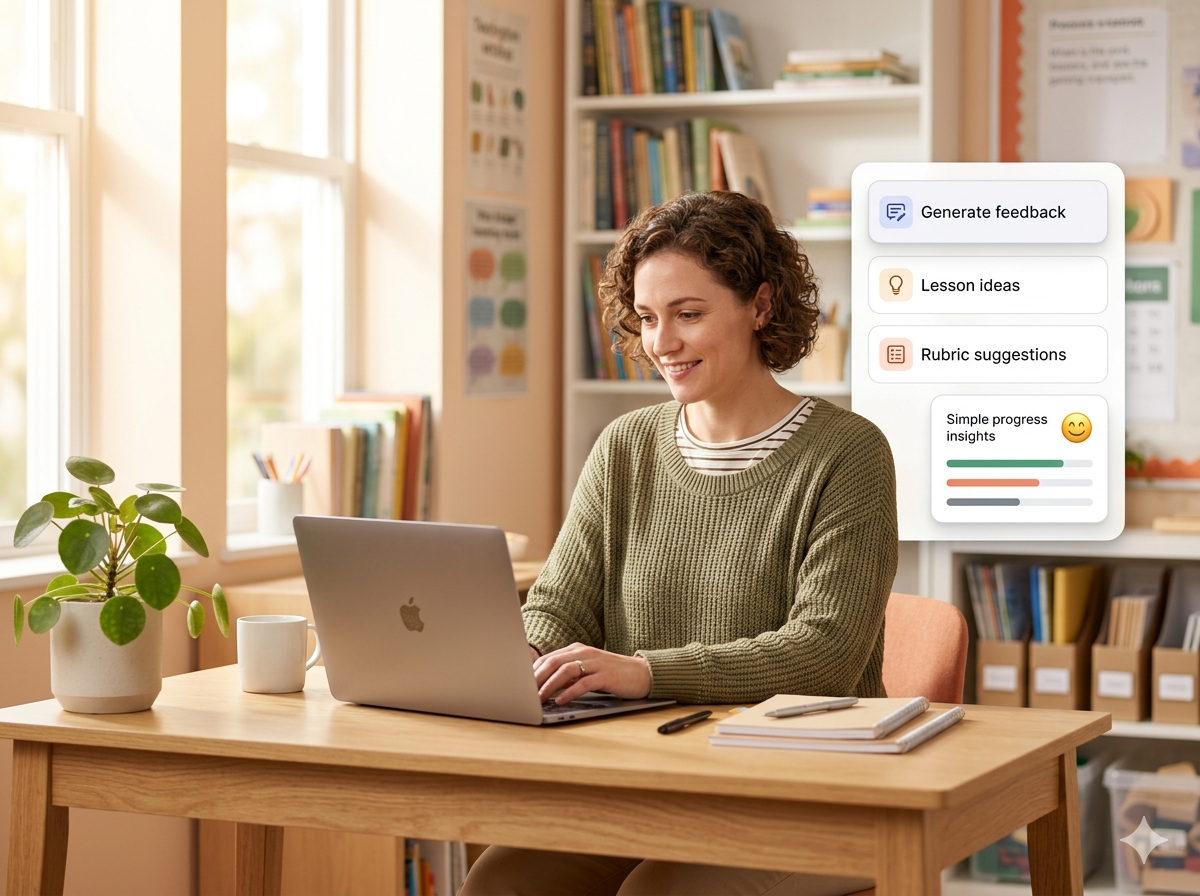
- Grading the first pass. Reading a full class set against your rubric and drafting specific feedback for every student.
- Drafting, not deciding. Turning a topic into a lesson, questions and a rubric you then refine, instead of starting from a blank page.
- Tracking. Keeping a live picture of who is improving and who is slipping, so patterns surface without a spreadsheet.
None of that is the human part of teaching. It is the admin that keeps getting in the way of it.
What stays the teacher's
Everything that requires judgement stays with you. You edit any comment before a student sees it. You override any mark. Nothing is published without your approval. The student-facing assistant gives hints, never answers, so the learning stays the student's own.
This is what "teacher in the loop" means in practice, and it is the difference between AI that supports teachers and AI that quietly pushes them out of the centre. The principle we hold to is simple: Zippy suggests, you decide.
Leverage, not replacement
Think of it as leverage rather than replacement. The same teacher, with the marking pile gone and progress visible at a glance, can give the thirty-first student the same attention as the first. The struggling one stops drowning because someone finally named the one fixable thing. The strong one stops coasting because someone finally stretched them.
So no, the goal is not to replace teachers. It is to reduce the workload that has been crowding out the work only teachers can do, and to give that time back.