
AI essay grading: how to mark a whole class without losing control

Marking a class set of compositions is the task that quietly eats a teacher's week. Thirty scripts, ten unhurried minutes each to do well, and it is already a working day no one has spare. AI essay grading is meant to give that time back, but only if it grades to your standard and leaves you in charge of every mark. Here is how that works in practice, and what to look for when you compare tools.
Why marking by hand does not scale
Most teachers do not mind marking one piece. What breaks them is volume. By the twentieth script the comments get shorter, vaguer and later, until the last few students get a number and five words in red. That is not a teaching choice. It is arithmetic: close reading takes time, and a full class of writing does not fit inside an evening.
The cost is hidden but real. The students who most need specific feedback, the ones drifting in the middle, are often the ones who get the thinnest comments, because they land at the bottom of the pile.
What AI essay grading actually does, and what it does not
Good AI grading is not a black box that spits out a number. Done properly, it does three things:
- Reads each piece against your rubric, the bands and descriptors you already use, not a generic scale.
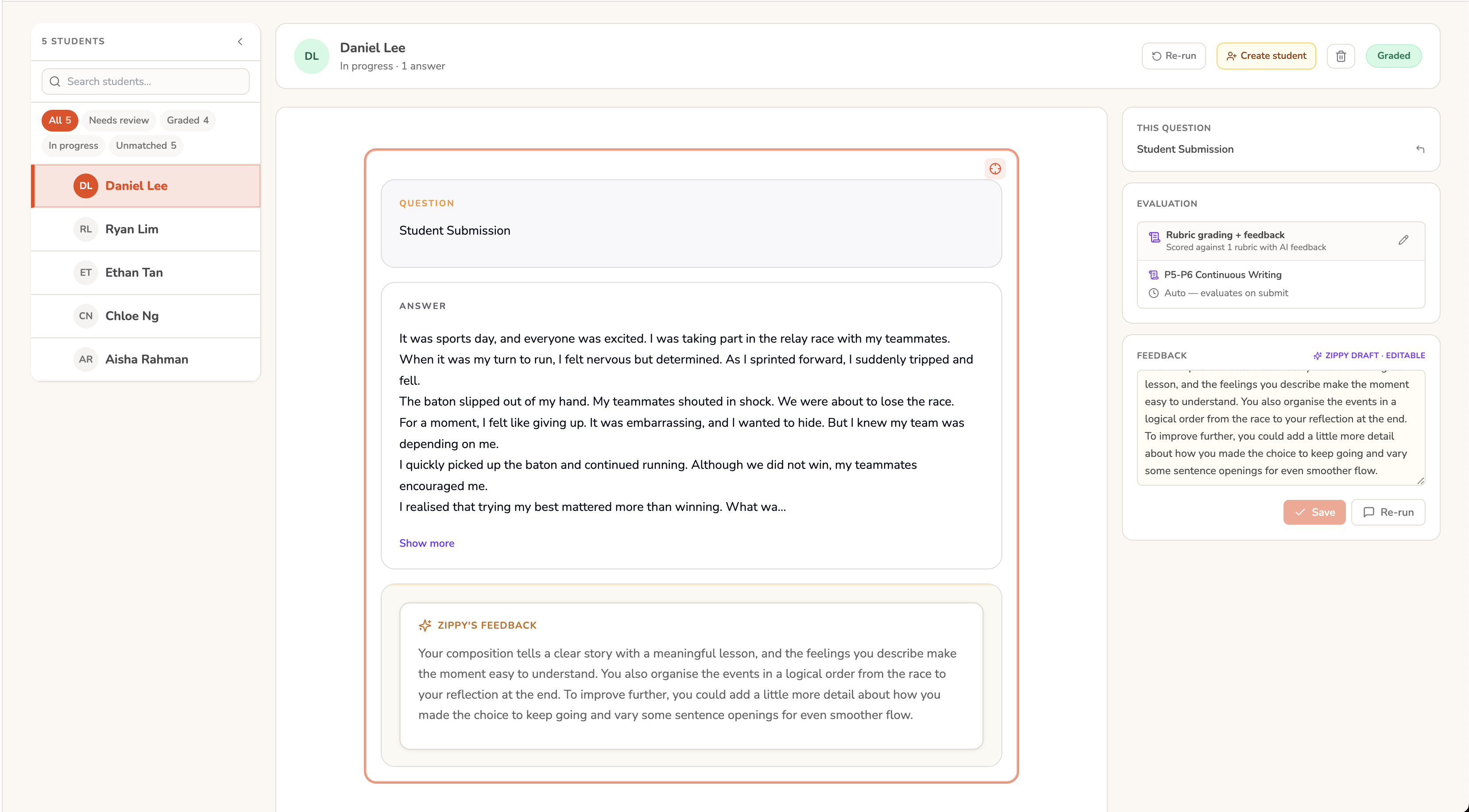
- Suggests a score for each criterion and drafts specific, skill-by-skill feedback tied to the actual writing.
- Hands all of it back to you as a draft to review, edit and approve.
What it does not do is publish anything on its own, or replace your judgement about a student you know had a rough week. The grading is a first pass. You are still the marker.
How to grade a whole class in one pass
The bulk grading workflow in Zippy looks like this:
1. Import the class set. Drop in a folder of scripts, or pull compositions straight from Google Docs. Zippy sorts the questions from the answers and groups submissions by student, so you are not renaming files at 10pm.
2. Grade against your rubric. Pick the rubric you teach to, for example a P5 or P6 Continuous Writing rubric with Content and Language bands, and Zippy reads every piece against it in one pass while you watch progress live.
3. Review the drafts. Each student comes back with a suggested band, a score, and inline feedback on specific phrases, not vague praise. Skim them the way you would skim your own marking.
4. Edit and approve. Change any mark, rewrite any comment, or re-grade a piece with one tap. Approve the class in a click. Nothing reaches a student or parent until you sign off, and every approval is logged.
Keeping control is the whole point
The worry with automated marking is that it flattens your standard into a button. The guardrails that prevent that are worth checking in any AI grading tool you consider:
- Your rubric, not a generic one. If the grading is not anchored to your bands and descriptors, the marks will drift.
- Editable everything. You should be able to override a score and rewrite a comment before a student ever sees it.
- Approval before release. No grade should go out without a teacher's sign-off.
With those in place, bulk grading is not "AI marking your class." It is you marking your class, faster, with the reading done for you.
Does AI grading match a teacher's marks?
This is the right question to ask, and the honest answer is that it depends on calibration. Zippy's rubrics are authored with experienced educators and anchored to local standards such as MOE and PSLE writing, so the bands mean what you expect them to mean. The practical test is simple: grade a script blind, then reveal what Zippy gave it, and see how often you agree. When you disagree, you override. Either way, you stay in control.
Where the saved hours go
Grading a class in minutes matters because of what the time buys back:
- The thirty-first student gets the same close read as the first.
- The saved evening goes to planning the next lesson, or to not working at all.
- Patterns surface across the class. Six students losing marks for the same skill is one reteach, not six separate problems.
That is the real promise of AI essay grading for teachers and tuition centres: not faster marking alone, but giving every student your full attention, every week.
If you want to see it on your own students' work, try Zippy's free composition grader. Paste in one piece and watch a number turn into a plan in about a minute.