
Marking a class set, without losing the evening

The marking itself is not the hard part. Any teacher can read a story and tell you what is working and what is not. The hard part is doing it thirty times, at the end of a week, to the same standard for the thirtieth child as for the first.
That is the bit that breaks. Not your judgement, your stamina.
What the pile actually costs
A class set of compositions is somewhere between two and four hours if you do it properly. Properly means reading the whole piece before you write anything, marking against the rubric rather than against the last script you read, and leaving a comment specific enough that the child can act on it.
Most teachers do not get to do it properly, and they know it. The comments get shorter as the pile gets smaller. The child at the bottom of the stack gets a worse deal than the child at the top, for no reason other than the order the books were collected in.
Consistency is the first casualty of volume. It is also the thing a rubric is supposed to protect.
Change what you start from
The change that helps is not speed. It is starting from a draft rather than a blank page.
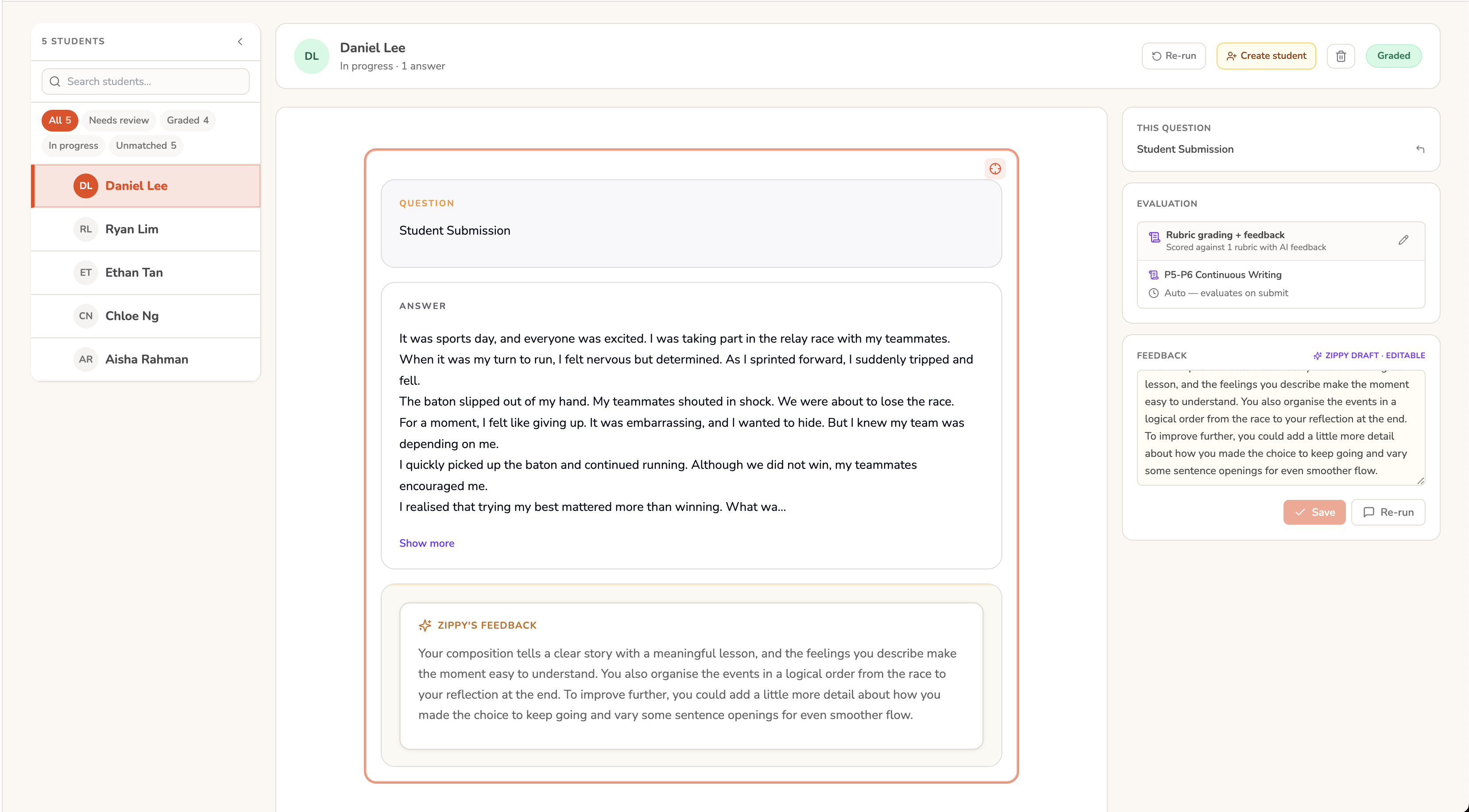
Zippy reads the whole class set against your rubric and drafts feedback for every student. When you sit down, the marking is already done once. Your job becomes reading, disagreeing, and adjusting, which is the part your judgement is actually for.
That flips the order of the work. Instead of generating thirty pieces of feedback from nothing, you are reviewing thirty pieces of feedback that already exist. Reviewing is faster than writing, and it holds up better at the end of a long day.
Handwriting is not an obstacle
Most of this work is still done on paper, so most tools that promise to help with marking quietly assume you will type it all in first. That is a second job in front of the first one.
Photograph the pile. Zippy transcribes each script and marks the transcription. A phone camera on a page of P5 handwriting is enough. You are not retyping anything.
What you get back
For each student: a score against each criterion in your rubric, a comment, a clear next step, and annotations marked in place on their own words. The annotations are the part children actually read, because they can see exactly which sentence the note is about.
For the class: the same standard applied to all thirty scripts, because the software does not get tired at script nineteen.
The part that stays yours
Nothing goes to a student until you approve it. You can change a score, rewrite a comment, or throw out the whole thing for one child because you know something about that child the rubric does not.
The objection we hear most is rarely about accuracy. It is "will it sound like me". So the draft stays a draft. You edit it the way you would edit a colleague's marking if you were moderating together, and what goes out is yours.
We are not claiming a measured jump in results. What we can say is that the first pass is done before you sit down, and that the thirtieth child gets the same attention as the first.
Try it on one set
The full walkthrough, step by step with a recording of the real thing, is in the guide:
Take a set you have already marked by hand and run it through. Compare it to your own marks. If it does not match your standard, it is not ready for your classroom, and you should not use it.
What the marks come out of is the rubric: how PSLE composition is marked and AI grading is only as good as the rubric behind it. What you do with a set once it is marked is in how to read a class gradebook.