
PSLE SBC Practice 3: Screen Time at Home (model answers)
How to use this page: cover the model answers, respond to each question out loud, then compare. The examiner notes explain where the marks are.
The stimulus
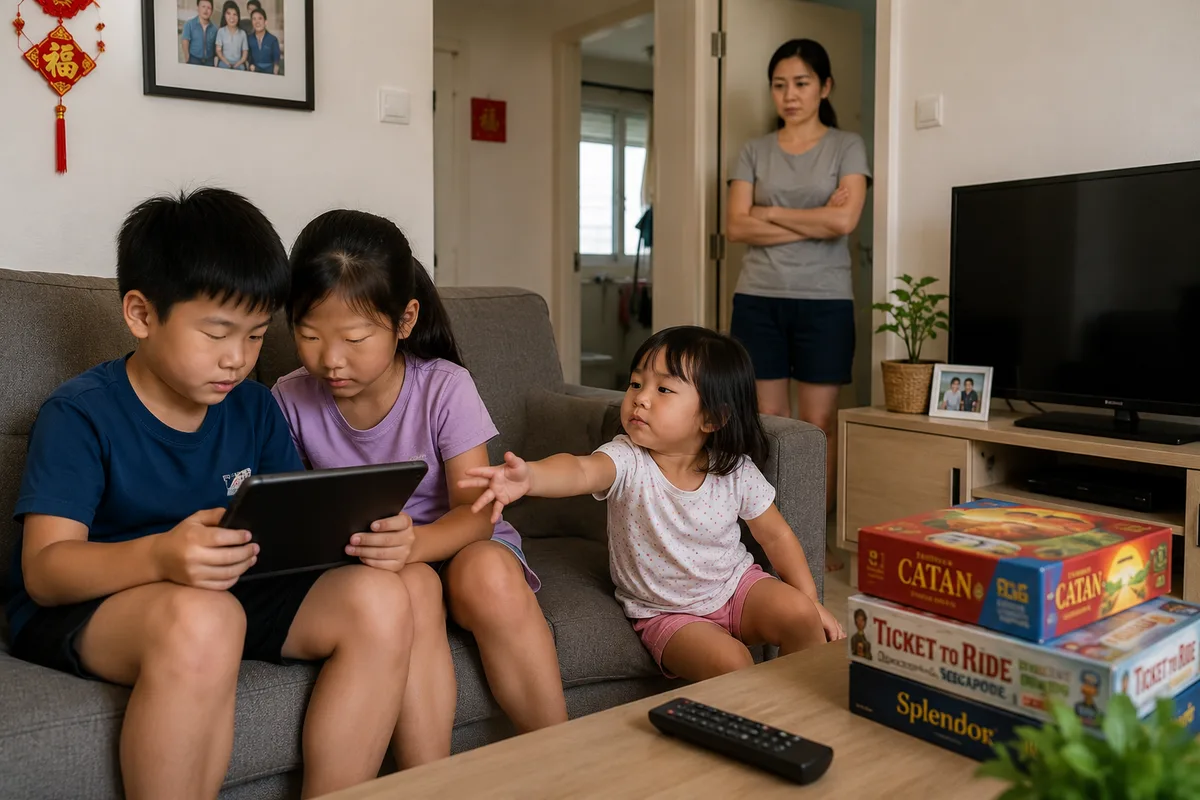
In a living room, two children sit close together on a sofa, both looking down at a tablet. A younger sibling nearby is trying to get their attention but is being ignored. A parent stands in the doorway with arms folded, looking a little concerned. A switched-off television and some untouched board games sit in the background.
In the real exam the stimulus is a photograph; this image stands in for one. Describe it as if you can see it.
Question 1, "Look at the people in the picture. How do you think they are feeling? Why do you say so?"
The 2026 first question is picture-based and asks you to read the people's feelings and back it up with what you can see, not just list objects. Different people in the photo may feel different things, and noticing that lifts your answer.
Weak answer: "The children feel happy using the tablet."
Strong answer: "I think the two children on the sofa are feeling absorbed and content, because they are leaning in close and staring at the tablet without looking up. The younger child, however, seems left out and a little upset, since he is trying to get their attention but is being ignored. The parent in the doorway looks worried, with her arms folded, and she may be concerned that they are spending too long on the screen while the board games sit untouched."
Examiner note: the weak answer names one feeling for everyone. The strong answer reads three different feelings, absorbed (the two children), left out (the younger sibling) and worried (the parent), and justifies each with a visible detail ("leaning in close", "trying to get their attention but ignored", "arms folded"). Spotting that different people feel differently is a sophisticated move the 2026 picture question rewards. Formula: "They feel ___ because I can see ___."
Question 2, "How much time do you usually spend on screens, and do you think it is too much?"
The mark is for a developed personal response, an honest example with some reflection.
Weak answer: "I use my phone a lot. Maybe too much."
Strong answer: "On school days, I usually spend about an hour on my tablet, mostly watching videos or playing a game after I finish my homework. On weekends it can be more, so I think it does become a little too much sometimes. I have noticed that if I watch too long, my eyes feel tired and I get less time to read or go outside. So lately I have been trying to set myself a limit, and I feel better for it."
Examiner note: the weak answer is vague and stops early. The strong answer gives a real figure, an honest admission, a consequence the child has noticed, and a small reflection on changing the habit. Specific and reflective beats vague every time.
Question 3, "Do you think parents should control how much screen time their children have? Why?"
A broader opinion question. The mark is for a clear, reasoned view, and it's fine to weigh both sides.
Strong answer: "I think parents should help set limits, though not control everything. On one hand, children do not always stop on their own, so a gentle limit, like the parent in the picture might be about to suggest, can protect their eyes and free up time for other things. On the other hand, if parents are too strict, children may not learn to manage screen time themselves. So I feel the best approach is for parents to guide and agree on limits together, rather than simply banning it."
Examiner note: the answer takes a position, supports it with reasons, considers a counter-view, and links back to the stimulus (the concerned parent). That balance and development is what separates a top oral answer from a plain "yes because screens are bad."
Practise the skill, not the script
These are models, not scripts to memorise. Rehearse the habits, describe the photo in full, and give every opinion a reason and a real example, on new photos each day. That flexibility is what the exam actually rewards.
Back to PSLE Oral Practice · Next: SBC Practice 4: A School Sports Day
Free practice from the team behind Zippy. Try the live grader →