
PSLE SBC Practice 1: Cooking Together at Home (model answers)
How to use this page: cover the model answers. Look at the photo description, answer each question out loud, then compare. The examiner notes show why the stronger answer scores.
The stimulus
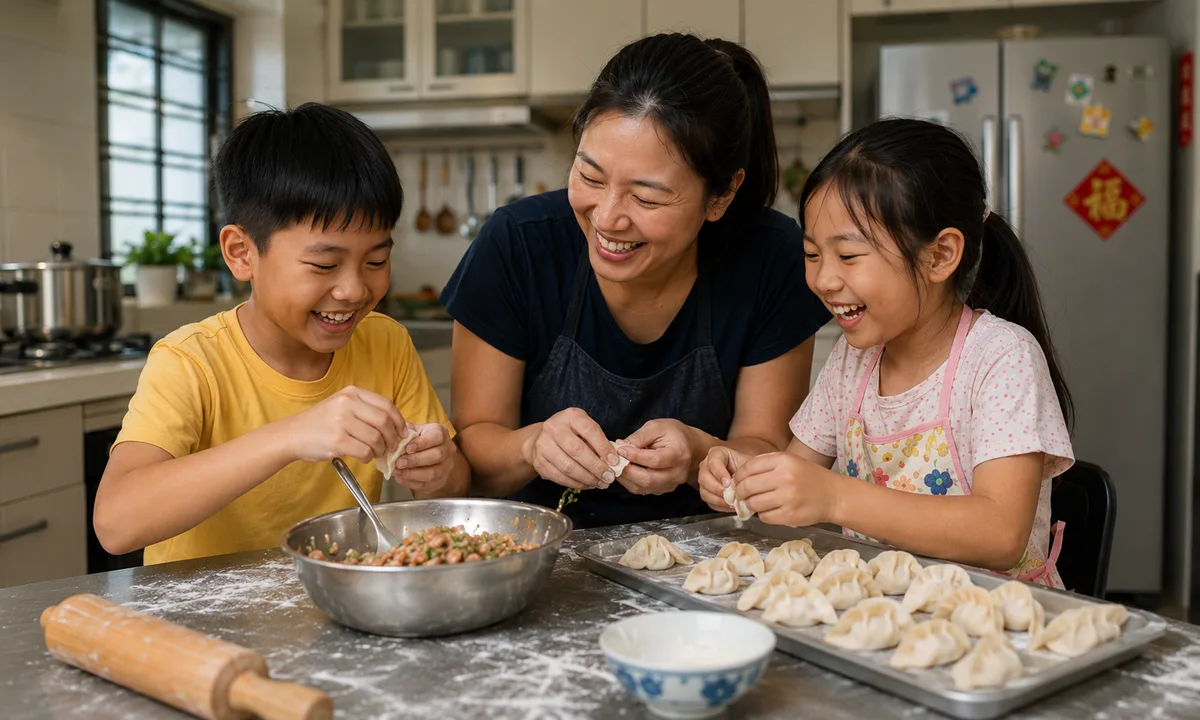
A parent and two primary-school-aged children stand at a kitchen counter making dumplings together. Flour is scattered on the counter, everyone's hands are busy, and all three are smiling and laughing. A bowl of filling and a rolling pin sit nearby.
In the real exam the stimulus is a photograph; this image stands in for one. Describe it as if you can see it.
Question 1, "Look at the picture. How do you think the family is feeling? Why do you say so?"
The 2026 first question is picture-based and asks you to read the people's feelings and back it up with what you can see, not just list objects. Name the feeling, then point to the evidence.
Weak answer: "They look happy. They are cooking."
Strong answer: "I think the family is feeling happy and relaxed. I say so because all three of them are smiling and laughing while they make dumplings together, so they seem to be enjoying each other's company. Even though there is flour scattered all over the counter, no one looks annoyed by the mess, they look like they are having fun. The two children also seem eager and involved, because their hands are busy shaping the dumplings rather than standing back and watching."
Examiner note: the weak answer names a feeling but gives no evidence, then slips into a bare description. The strong answer names the feeling (happy, relaxed, eager) and justifies each one with a detail from the photo ("smiling and laughing", "no one looks annoyed by the mess", "their hands are busy"). Feeling plus evidence is exactly what the 2026 picture question rewards, and a quick formula is "They feel ___ because I can see ___."
Question 2, "Do you enjoy helping to prepare food at home? Why or why not?"
Now the question opens out to the child's own experience. The mark is for a clear opinion backed by a reason and example, not a one-word yes/no.
Weak answer: "Yes, because it is fun."
Strong answer: "Yes, I really enjoy it. For example, I help my grandmother wash and cut the vegetables when she cooks dinner. I like it because she teaches me little tricks, like how to tell when the soup is ready, and it means we get to chat while we work. So for me, helping in the kitchen is both useful and a nice way to spend time with her."
Examiner note: the weak answer gives an opinion but no substance. The strong answer states the view, gives a specific example ("wash and cut the vegetables"), explains why it matters, and rounds off the point. Point, then example, then reason, that shape turns a one-liner into a complete answer.
Question 3, "Some people say families today spend too little time together. What do you think?"
A broader opinion question on the theme. The mark is for a thoughtful, organised response, it's fine to see both sides.
Strong answer: "I think there is some truth to that. These days, parents are often busy with work and children have a lot of homework and activities, so it can be hard to find time together. However, I believe families can still make small moments count, like having dinner together or cooking on weekends, as in the picture. So rather than needing lots of time, I think it is about using the time we have well."
Examiner note: this answer shows maturity by acknowledging the concern, then offering a balanced view with an example that links back to the stimulus. Examiners reward a child who can develop an idea and stay relevant, not one who simply agrees in a sentence.
Practise the skill, not the script
Don't memorise these answers, the examiner can tell, and it reads as unnatural. Instead, practise the habit: read the feelings in any photo and name them with evidence, and back every opinion with a reason and an example. Do it on three different photos tonight and it starts to become automatic.
Next: SBC Practice 2: A Community Clean-Up · Back to PSLE Oral Practice
Want the full method? Read How to Answer Any SBC Photo.
Free practice from the team behind Zippy. Try the live grader →